

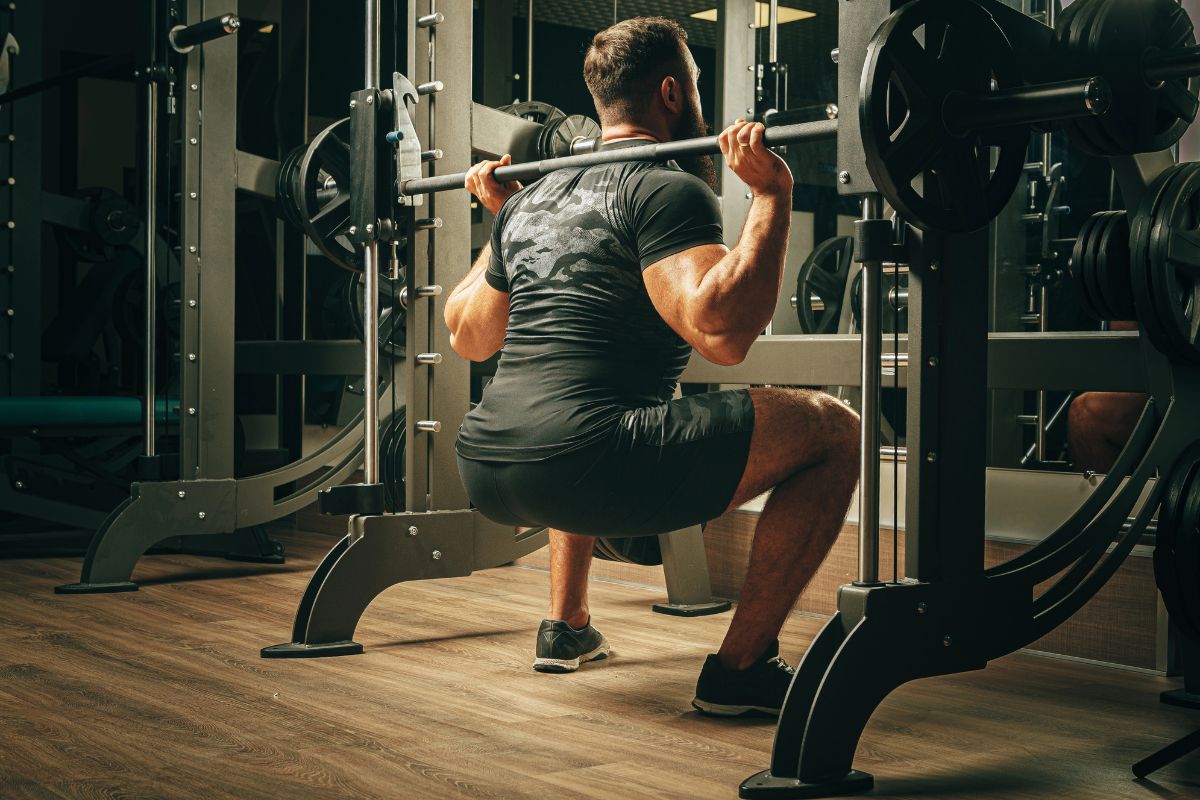
Why Barbells Build More Functional Strength
One of the biggest benefits of barbells is they offer superior functional strength and muscle activation. When using a barbell movements are made in three-dimensional space, forcing you to balance and stabilize the bar manually. It activates those smaller ‘stabilising’ muscles such as your core (abdominals, obliques, erector spinae) and the inner leg muscles (adductors).
The Research Supports It
Research has consistently shown that free weights demand greater muscle activation than fixed-path machines. A study published in the Journal of Strength and Conditioning Research compared muscle activity during the bench press using a free-weight barbell and a Smith machine at 90% of each participant’s one-repetition maximum.
The researchers found significantly greater activation of the anterior deltoid, medial deltoid and pectoralis major when participants used a free-weight barbell. They concluded that the additional stability required during free-weight lifting resulted in greater neuromuscular demand, recommending that strength coaches choose the free-weight bench press when the goal is developing strength and muscular coordination[1].
Barbells Fit Your Body, Not the Other Way Around
Unlike a barbell, which allows your body to find its own natural movement path, the Smith machine locks the bar into a fixed vertical track. Since no two people are built exactly the same, this restriction can prevent lifters from squatting in the way that’s most efficient and comfortable for their individual anatomy, which we discussed in more detail here. In contrast, barbell squats allow you to adjust your torso angle, bar path, and stance naturally, resulting in a movement that’s better suited to your body’s mechanics.
Better for Injury Prevention and Rehabilitation
Strong stabilising muscles don’t just improve performance, they also play a key role in injury prevention and rehabilitation. For example, weakness in the rotator cuff muscles often cause muscular imbalances which can lead to larger shoulder issues over time. Due to barbells requiring constant work from these stabilising muscles, they can help restore strength and coordination during rehabilitation.
Smith Machine Strength Isn’t the Same as Barbell Strength
Lastly, strength on a Smith machine is not a representation of true strength. It does not resemble natural everyday movements and doesn’t use your bodies natural range of motion. If you were to squat 100 kilograms on a smith machine, you would not be able to recreate that on a barbell squat. I would say if you don’t believe me to give it a go, however, for your own safety I was seriously advise not too!
To Conclude…
While the Smith machine can be a useful tool in certain situations, it should not replace barbell training if your goal is to build strength. Barbells recruit more muscles, improve balance and coordination, allow natural movement patterns. As well as developing strength that transfers beyond the gym. For most lifters, mastering the barbell will produce greater long term results.
References
- Schick EE, Coburn JW, Brown LE, Judelson DA, Khamoui AV, Tran TT, et al. A Comparison of Muscle Activation Between a Smith Machine and Free Weight Bench Press. Journal of Strength and Conditioning Research. 2010 Mar;24(3):779–84.
