

How does the femur affect the squat?
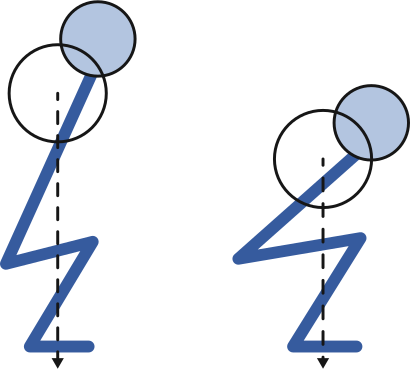
Starting with the basics, the femur, also known as the thigh bone, is the longest, heaviest and strongest bone in the body. The main influence the femurs have on the squat is what’s referred to as your back angle (whether you are more or less bent over in your squat) which can be affected in one of two ways. Typically, those with shorter femurs and long torsos have a much lesser back angle (less bent over) whereas those with longer femurs and shorter torsos have a greater back angle (more bent over).
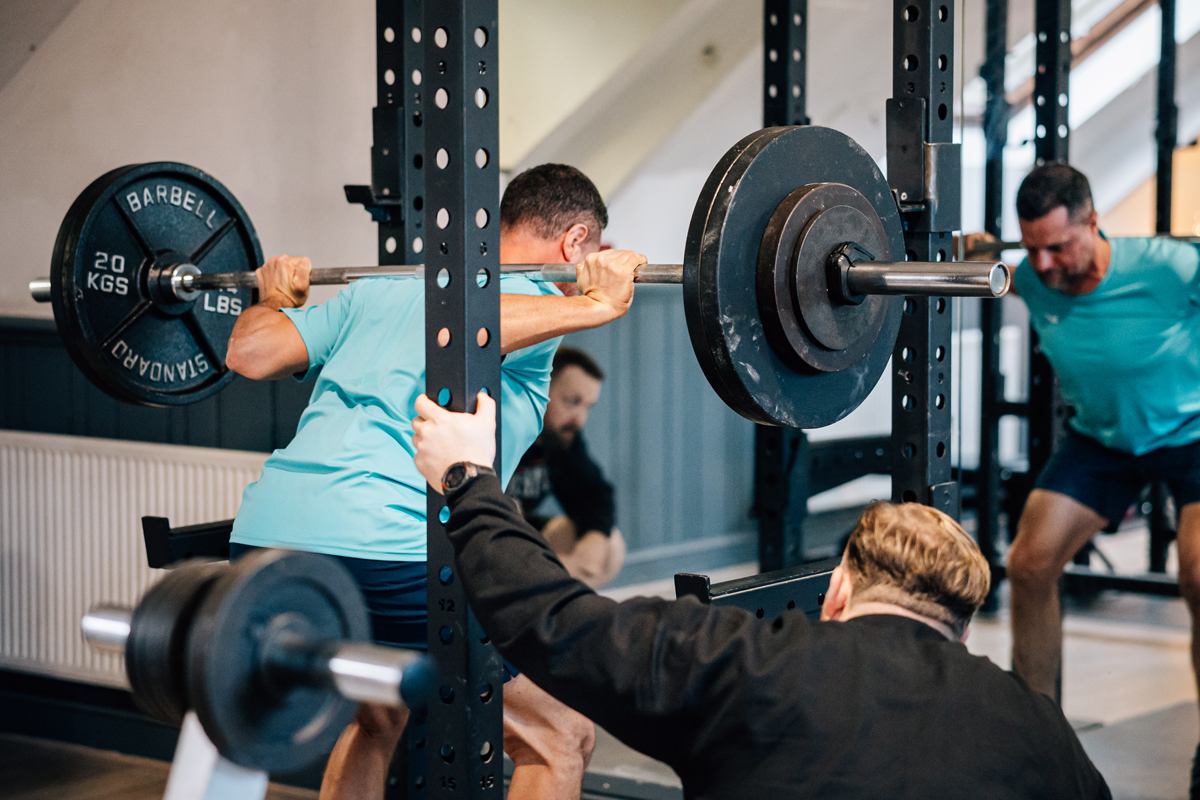
One of the main reasons this occurs revolves around centre of gravity. In order to maintain balance in any situation, your centre of gravity must be ‘over your base of support’. Meaning your contact with the ground, with the squat this would be your mid foot. In a low-bar back squat the barbell (load) is situated on your back, just below the spine of the scapula. Therefore, our goal is to keep this load centered over the mid foot and create as vertical a bar path as possible. In order to achieve this, someone who has proportionally longer femurs, will have to push the hips further back, and will have to bend over more to keep the centre of gravity over the mid foot. When people who have longer femurs try to avoid bending over and adopt a more vertical back angle, it pushes the centre of gravity away from the base of support, leading to an inefficient bar path, loss of balance and instability in the squat.
Looking at a study performed in 20172. It was found that when performing maximum repetitions at 70% of peoples one rep max, those with the 10 longest femurs significantly underperformed compared to those with the shortest. With the group with shorter femurs completing on average 19 repetitions compared to 14 in the group with the 10 longest femurs. This is as a result of having a longer femur, it requires more of a range of motion in order to reach depth in the squat. Leading to a fatigue of the muscles having to work longer and harder for each resp, when comparing someone with a shorter femur.
How can you overcome excessive forward lean?
In order to prevent excessive forward leaning during the squat, there are a few different methods that can be used.
Weightlifting shoes help to prevent an excessive forward lean, elevating the heels allows increased ankle dorsiflexion (toes to shins). In short, allowing the hips to not have to be pushed back as far, subsequently meaning there is less demand in leaning forward to keep balance.
Working on mobility in key joints such as the ankle and the hips can help when trying to get depth in the squat and can prevent excessive leaning when squatting. Better mobility allows for the lower back to take less excessive strain while squatting as the weight can be dispersed more evenly through the hips.
Having a strong back and being able to maintain spinal extension whilst squatting allows the squatter to maintain a rigid torso angle. As well as being able to centralise weight over the midfoot, a common error when squatting is moving the body in two phases. Lifting the hips, then, lifting the torso causing the chest to excessively drop forward. Whereas for a more efficient squat the body should all move as one unit. The best way to correct this would be to make sure the trunk musculature is engaged throughout the movement and strengthen the back through exercises such as deadlifts, or lower back extensions.
Does femur length affect your ability to do strength training?
Ultimately, no, with correct technique and coaching, someone’s anthropometrics has no effect on their ability to squat. Educating clients on how this can affect their squat technique is important at Body Mentors, in order to make the squat much more natural for each specific client.
References
- Sciatic Nerve: What Is, Anatomy, Function & Conditions [Internet]. Cleveland Clinic. 2021. Available from: https://my.clevelandclinic.org/health/body/21618-sciatic-nerve
- Cooke DM, Haischer MH, Carzoli JP, Bazyler CD, Johnson TK, Varieur R, et al. Body Mass and Femur Length Are Inversely Related to Repetitions Performed in the Back Squat in Well-Trained Lifters. Journal of Strength and Conditioning Research. 2019 Mar;33(3):890–5.
