

Stress
Stress when training comes in many forms. One of these being metabolic stress (changes that are made to the body during intense exercise) which is the key component in gaining strength. In order to get metabolic stress training should be performed with weights greater than 70% of someone’s one rep max. For example, someone with a 100 Kilogram (KG) squat one rep max, should be lifting at least 70KG in a strength training rep range. American College of Sports Medicine¹ quote training to metabolic stress being essential for getting stronger in a 2009 study.
Recovery
Recovery is another key component to optimising strength training, which can be broken down also into different categories.
Rest – allowing the body time to heal after putting a lot of stress through the muscles and similar tissues, this can be done through getting adequate sleep (7-9 hours). Which will aid in muscle repair and hormone regulation.
Nutrition – A high protein diet, especially after a workout is pivotal for recovery, proteins enhances recovery, immune function as well as growth of muscle to occur. The rule of thumb for protein consumption is roughly 1.5g to 1.8g/kg of bodyweight for women, and 1.8g to 2.2g/kg of bodyweight for men. For example, someone a male weighing 100KG should consume anywhere between 150-180 grams of protein daily. With timings of protein being consumed i.e. before or after strength training being irrelevant2.
Training splits – For those who like to train multiple times a week, even multiple days in a row, programming each session strategically is key. Having repeat sessions, such as leg day two days in a row does not allow enough time for those muscles to recover and adapt. A way to prevent this would be to have set muscle groups on certain days, or to have multiple days of rest in between sessions. This allows each muscle that has been stressed time to recover before its next session.
Adaptation
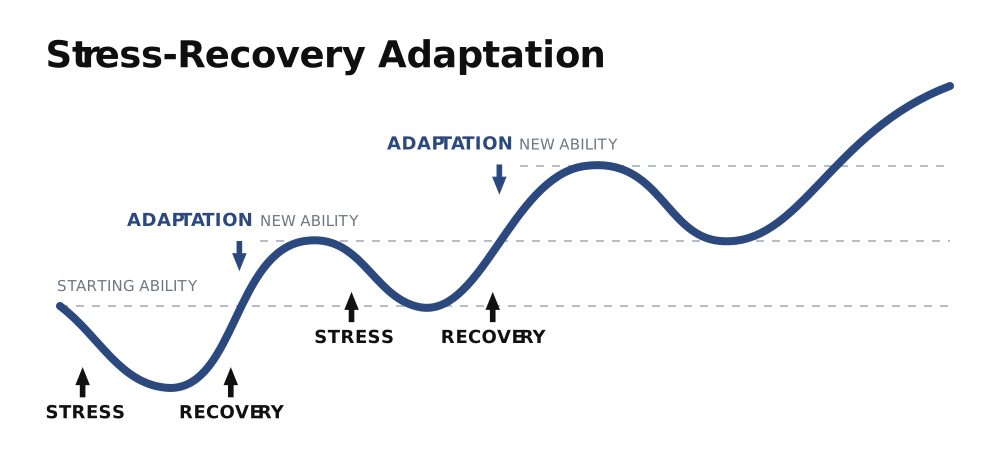
Adaptation occurs when the body is put under enough stress, and has had enough recovery.
There are ample different adaptations that occur throughout the body and its different tissues, some of these include.
Muscular adaptation – Strength training causes two main adaptations to occur within muscles, one being that hyperplasia is increased (the number of muscle fibres). This is where new muscle fibres are made and can aid in the overall size and strength of a muscle. Muscles also go through a process called hypertrophy, this is specific to the increase in muscle fibre size. This occurs when the number of myofibrils (contractile tissue within the muscle) increases, causing muscles to grow and become larger. Ultimately, being able to produce more force.
Neuromuscular adaptation – This refers to your ability to engage muscle fibres, which is done through a process called motor unit recruitment (the nervous systems control of muscle movement) which plays a pivotal role in increasing force production3. Think of this as making your muscles work more efficiently. These adaptations do plateau rather quickly however, often within a few weeks or months and are heavily affected by your genetics, making this adaptation great for short term improvements.
Tendon adaptations – Tendons also become a lot stronger, this helps transferring force more efficiently. Leading to a more enhanced athletic performance, reduce injury risk and improve overall joint stability. This is done through stimulating collagen synthesis (a structural protein providing strength, flexibility and support) which causes the tendons themselves to become stronger and more durable.
Bone adaptations – Strength training causes bones to adapt also, causing a trigger in bone cells to build more bone tissue, increasing the mineral density and overall improving bone structure. This can lead to a decrease in the risk of bone related conditions such as osteoporosis and osteomalacia.
By having enough stress and recovery it puts the body in the best possible position to create these adaptations. This is what allows you to make progress when training consistently, reduce your risk of getting injured, be stronger and functional in everyday life.
References
- American College of Sports Medicine. Progression models in resistance training for healthy adults. Medicine & Science in Sports & Exercise [Internet]. 2009;41(3):687–708. Available from: https://pubmed.ncbi.nlm.nih.gov/19204579/
- Cintineo HP, Arent MA, Antonio J, Arent SM. Effects of Protein Supplementation on Performance and Recovery in Resistance and Endurance Training. Frontiers in Nutrition [Internet]. 2018 Sep 11;5(83). Available from: https://pmc.ncbi.nlm.nih.gov/articles/PMC6142015/
- Bernárdez-Vázquez R, Raya-González J, Castillo D, Beato M. Resistance Training Variables for Optimization of Muscle Hypertrophy: An Umbrella Review. Frontiers in Sports and Active Living [Internet]. 2022 Jul 4;4(4). Available from: https://www.frontiersin.org/journals/sports-and-active-living/articles/10.3389/fspor.2022.949021/full
- Liu Z, Chen J, Lin Z. Neuromuscular control and biomechanical adaptations in strength training: Implications for improved athletic performance. Molecular & Cellular Biomechanics. 2025 Mar 24;22(5):1709.
