

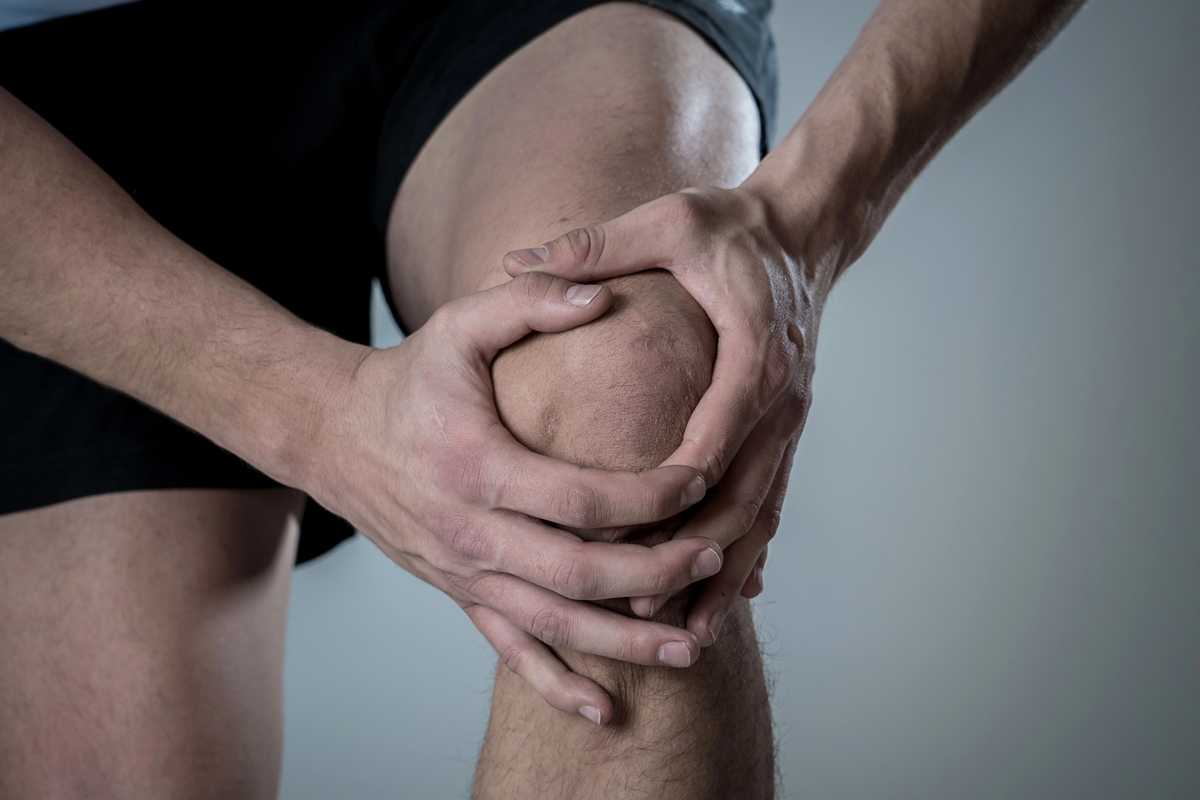
The ACL is one of four integral ligaments located in the knee.
- Anterior cruciate ligament (ACL)
- Posterior cruciate ligament (PCL)
- Medial cruciate ligament (MCL)
- Lateral cruciate ligament (LCL)
Causes of an ACL injury
The most common ways for the ACL to become injured consist of the following1:
- A sudden stop in movement, most commonly when running
- Landing from a jump
- Excessive movement of the knee joint to the right or left which can be caused by impact or blows to the knee
The injury itself can be extremely debilitating and can happen in isolation or with other injuries occurring during the same movement, most often the meniscus or MCL. The ACL’s core function is to prevent excessive forward or ‘sliding’ movement of the lower leg (tibia) away from the upper leg (femur). When the force applied in this movement is too great, injuries can then occur. This leads to mass instability within the knee, prompting people to think their knee is constantly going to ‘give way’ whilst performing basic movements.
Treatment for an ACL injury
When suffering with an ACL injury, there are two routes you can go down, non operative, or operative. In recent times the rate of surgery has increased significantly for teenagers as a result of surgical advancements. With teenagers being twenty-nine times more likely to have surgery compared to twenty years ago. Contradicting the trend for the older population, where alternatives such as rehab without surgery has increased throughout the last few years.
There are pros and cons to both, with there not really being a correct answer. For elite athletes having the surgery more readily available makes it a more viable option, whereas for ‘non elite athletes’ who have to rely on the NHS often have to wait months before getting the surgery.
Whether you decide to have surgery or not, the rehabilitation process is similar. Research2 has suggested that following a criteria based programme as opposed to a traditional time based approach can be more effective. This consists of being able to achieve full range of motion of the knee, having equal strength in the surrounding muscles and plyometric based exercises. This is an approach we utilise at Body Mentors.
In order to prevent any ACL injury, building strength of the lower limbs is key, especially the hamstrings, given they have a similar role within the knee as the ACL in preventing forward movement of the femur.
If you are recovering from an ACL surgery, or are about to have one and need to be in the best condition get started below.
References
- 1.O’leary S. Anterior Cruciate Ligament (ACL) Reconstruction Patient information [Internet]. 2019. Available from: https://www.seanolearyknee.co.uk/pdfs/acl-reconstruction.pdf
- Cooper R, Hughes M, Based G. ACL Melbourne ACL Rehabilitation Guide 2.0 A criteria driven ACL rehabilitation protocol and guide for both clinicians and people who have undergone a surgical reconstruction of the Anterior Cruciate Ligament (ACL). Melbourne ACL Rehabilitation Guide ACL Rehab [Internet]. 2018. Available from: https://www.fitasaphysio.com/uploads/4/3/3/4/43345381/melbourne_acl_rehabilitation_guide_-_fergus_tilt.pdf
