

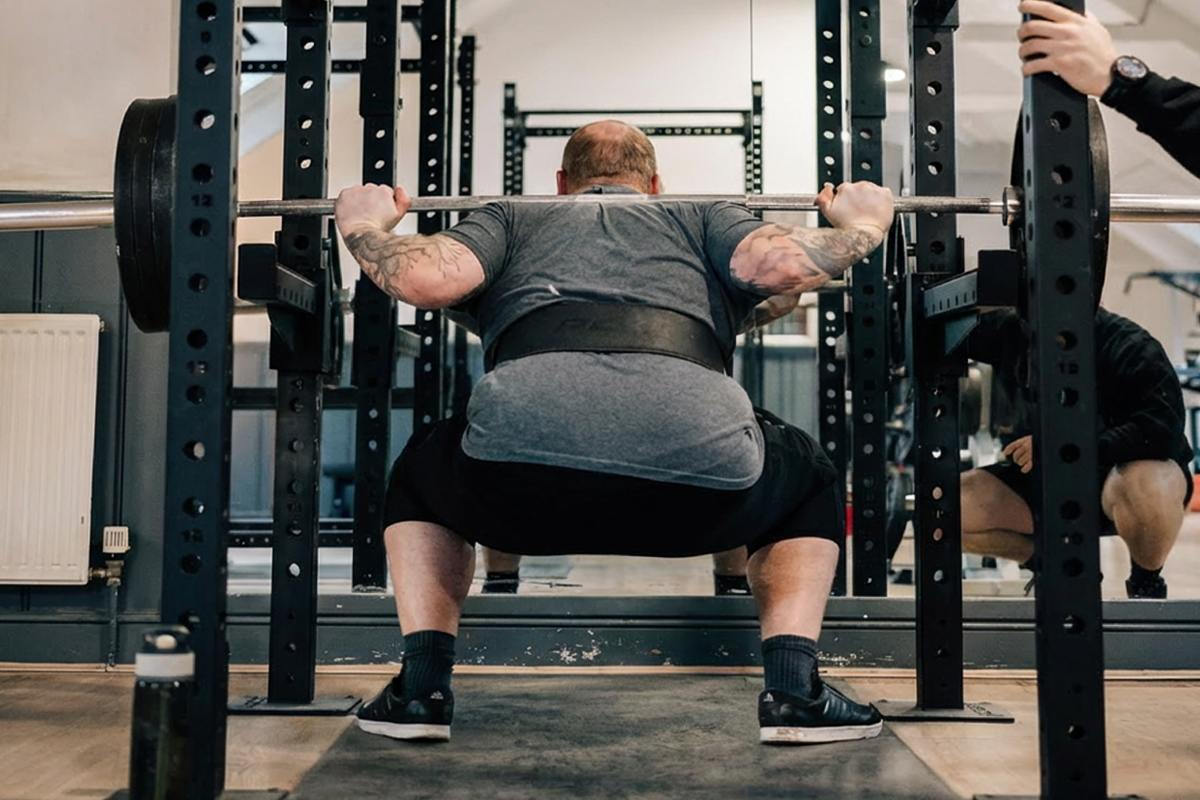
Full depth is crucial for functional strength
Partial squats build partial strength. Partial squats train you to be strong only where you’re comfortable, not through the full range that actually matters. Over time, that limited movement becomes your new normal.
Working in a limited range of motion (ROM) only builds strength within that range. Anytime you move outside of your comfortable range, weakness or breakdowns in form can occur, increasing the risk of injury.
Squatting at full depth builds strength at the end range of the hip, which is essential for functional mobility. Regularly performing deep squats teaches your joints to move efficiently in a full range of motion. Over time, this can improve hip flexibility and control. Strong muscles around the hips allow you to move through deeper positions safely, reducing the risk of compensations elsewhere, like in the lower back or knees. Being able to squat well isn’t a performance standard — it’s the bare minimum to build a body that’s strong, stable, and built to move without pain.
Full depth is a non-negotiable
If you’re struggling to hit depth, drop the ego and reduce the weight. Focus purely on hitting depth, and once you achieve full depth and get the feel of where it is, then start to increase the weight using progressive overload.
Full depth allows you to engage the posterior chain into the squat. The posterior chain includes the back, hamstring, and glutes. With more muscle mass used in a movement, the more efficient it is, allowing you to lift heavier. Full depth equals full ROM in a squat. Simply put, a squat is a sitting and standing movement, which everybody performs multiple times a day. So, working and building strength in a full range will build strength in a full range, making everyday tasks a lot easier. If you can squat any weight on the bar, you can easily get up and down from a chair.
When any muscle is put into its full ROM, a natural ‘stretch’ response occurs when the muscle almost bounces back from its lengthened position. This natural response can help a lot when getting back up from a squat, essentially giving you a bounce back up from the bottom of a squat.
Full depth can be a goal to work towards!
If reaching full depth is a struggle, set it as a goal. Instead of increasing weight as your progression measure, use depth. For example, start with a box or bench and gradually reduce the height over sessions. An example would be to start with a bench and add a 20-kilo bumper plate on top. The bumper plate is a marker that you should physically touch every rep. Once that depth becomes easier to reach, then swap out the 20-kilo plate for a 15-kilo plate, which will be slightly lower. This trend can be followed until you either hit full depth or wherever your full depth is. Using smaller plates as a progression will reduce the depth you’ll have to get to in order to make contact with the plate. This is an effective method, as there is no grey area — you either hit the plate and therefore complete the rep or fall short, not making contact with the plate and failing the rep. This instant feedback allows you to develop a feel for where full depth is and where you need to reach in order to complete the rep.
With consistency and effort, your depth will improve. Increasing your squat depth not only builds strength but also improves everyday functionality. Some examples are reaching under furniture, bending down to pick something up, or any movement requiring hip mobility. The functional benefits of full-depth squatting are enormous and can be achieved with a bit of work by anyone, regardless of age or activity level.
